Industrial Pumps Explained: Pump Types, Manufacturing Processes, Pump Technologies, Components, Global Manufacturers, Suppliers and Industrial Applications
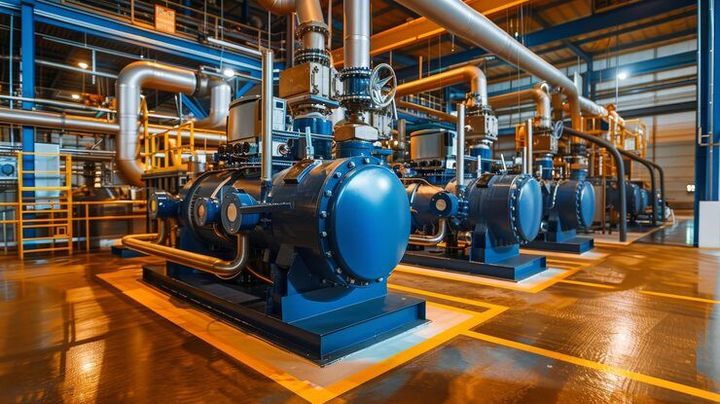
Industrial pumps are mechanical devices designed to move liquids, chemicals, slurries, and other fluids through pipelines, processing equipment, storage systems, and industrial facilities. They play an essential role in manufacturing, water treatment, oil and gas processing, chemical production, power generation, mining, agriculture, and pharmaceutical operations. Different pump configurations are developed to handle specific fluid properties, flow requirements, pressure conditions, and operating environments.
Industrial pump technology has evolved through improvements in hydraulic engineering, mechanical design, materials science, sealing systems, and motor efficiency. Modern pumping equipment incorporates variable-speed drives, automated controls, condition monitoring, and specialized materials to support different industrial processes. Centrifugal, positive displacement, submersible, diaphragm, and multistage pumps represent important categories within the global pump manufacturing industry.
Understanding industrial pump types, operating principles, manufacturing processes, components, and technical specifications is important when evaluating equipment for industrial applications. This guide explores major pump technologies, manufacturing methods, global manufacturers, suppliers, industrial applications, maintenance requirements, and developments influencing the pumping equipment market.
Understanding Industrial Pumps and Their Importance
An industrial pump is a mechanical device that transfers fluid by converting mechanical energy into hydraulic energy. The energy is generally supplied through an electric motor, diesel engine, hydraulic drive, or another power source.
Pumps are used to move fluids from one location to another, maintain circulation, increase pressure, and support continuous industrial operations. Their design depends on factors such as fluid viscosity, temperature, density, chemical composition, required flow rate, and operating pressure.
Industrial pumping systems generally consist of a pump, motor, coupling, piping network, valves, control equipment, and supporting accessories. Some installations also include filtration systems, pressure sensors, storage tanks, and automated monitoring equipment.
Common applications include:
Water supply and distribution.
Wastewater treatment and sewage handling.
Chemical transfer and processing.
Petroleum and natural gas operations.
Industrial cooling and heating systems.
Food and beverage manufacturing.
Pharmaceutical production.
Mining and mineral processing.
Agricultural irrigation.
Power generation and boiler feed systems.
Main Types of Industrial Pumps
Industrial pumps are generally classified into two broad categories: dynamic pumps and positive displacement pumps. Each category operates through a different mechanical principle and is suitable for specific fluid-handling requirements.
Centrifugal Pumps
Centrifugal pumps use a rotating impeller to transfer mechanical energy to a liquid. The impeller accelerates the fluid, while the pump casing helps convert velocity energy into pressure.
These pumps are widely used in water treatment, chemical processing, cooling systems, irrigation, and general industrial fluid transfer.
Common centrifugal pump configurations include:
End-suction centrifugal pumps.
Split-case centrifugal pumps.
Inline centrifugal pumps.
Vertical turbine pumps.
Multistage centrifugal pumps.
Self-priming centrifugal pumps.
Their suitability depends on the required flow rate, pressure, liquid properties, and installation arrangement.
Positive Displacement Pumps
Positive displacement pumps transfer fluid by trapping a defined volume and mechanically moving it through the discharge system.
They are commonly used for high-viscosity fluids, controlled chemical dosing, and applications requiring relatively consistent flow.
Important types include:
Gear pumps: Use rotating gears to move liquids through the pump housing. They are used for oils, lubricants, and certain industrial chemicals.
Screw pumps: Use one or more rotating screws to transport fluids. Their applications include petroleum processing, marine systems, and industrial lubrication.
Piston pumps: Use reciprocating pistons to move fluid through inlet and outlet valves. They are used in high-pressure industrial systems.
Plunger pumps: Use reciprocating plungers to generate high-pressure fluid movement. They are found in cleaning systems, chemical injection, and industrial processing.
Diaphragm Pumps
Diaphragm pumps use a flexible membrane to move liquids through a pumping chamber. The diaphragm creates alternating suction and discharge movements.
Air-operated double-diaphragm pumps use compressed air to operate the pumping mechanism. They are commonly used for transferring chemicals, wastewater, slurries, and liquids containing suspended solids.
Submersible Pumps
Submersible pumps operate while immersed in the liquid being pumped. Their motor and pumping components are designed for the intended underwater operating conditions.
These pumps are widely used in wastewater management, drainage, borewell water extraction, mining, and industrial water handling.
Multistage Pumps
Multistage pumps contain multiple impellers arranged in series within a single pumping assembly.
Each stage contributes additional pressure to the fluid, making these pumps suitable for applications requiring higher discharge pressure.
Common applications include boiler feed systems, industrial water supply, pressure boosting, and reverse osmosis installations.
Comparison of Major Industrial Pump Types
| Pump type | Operating principle | Common applications |
|---|---|---|
| Centrifugal | Rotating impeller | Water transfer and cooling |
| Gear | Rotating gear displacement | Oils and lubricants |
| Screw | Helical screw movement | Petroleum and viscous fluids |
| Piston | Reciprocating piston | High-pressure applications |
| Diaphragm | Flexible membrane movement | Chemical and wastewater transfer |
| Submersible | Immersed pumping assembly | Drainage and sewage |
| Multistage | Multiple impeller stages | Boiler feed and pressure boosting |
Industrial Pump Manufacturing Processes
Pump manufacturing involves several engineering and production stages. The exact process depends on pump design, material selection, operating pressure, fluid compatibility, and manufacturing volume.
Material Selection and Component Design
Manufacturers select materials according to the liquid being handled and the operating environment.
Common materials include cast iron, stainless steel, carbon steel, bronze, aluminium alloys, and specialized corrosion-resistant alloys.
Engineering teams evaluate pressure requirements, temperature limits, corrosion resistance, wear characteristics, and mechanical strength before finalizing component designs.
Casting and Metal Forming
Pump casings, impellers, housings, and other metal components may be manufactured through casting or metal-forming processes.
Sand casting, investment casting, and other specialized casting methods are used depending on component geometry, material, and production requirements.
After casting, components undergo cleaning, surface preparation, and dimensional inspection.
CNC Machining and Precision Manufacturing
Computer numerical control (CNC) machines are used to manufacture precise pump components.
Turning, milling, drilling, grinding, and balancing operations help produce shafts, impellers, bearing housings, and sealing surfaces.
Dimensional accuracy is particularly important because component alignment and clearances influence hydraulic performance and mechanical reliability.
Assembly and Sealing
Manufactured components are assembled into the pump structure. Bearings, shafts, impellers, mechanical seals, gaskets, and couplings are installed according to engineering specifications.
Mechanical seals and packing systems help control leakage around rotating shafts.
The assembly process also includes alignment checks and appropriate lubrication arrangements.
Testing and Quality Inspection
Finished industrial pumps undergo inspection and performance testing.
Depending on the equipment category, tests may examine:
Flow rate and discharge pressure.
Hydraulic performance and efficiency.
Vibration and noise.
Mechanical seal leakage.
Motor operation and electrical characteristics.
Pressure resistance and structural integrity.
Material quality and dimensional accuracy.
Performance testing helps establish whether the equipment meets its specified operating requirements.
Important Industrial Pump Components
Industrial pumping equipment contains several interconnected components that influence fluid movement and mechanical performance.
Pump casing: Encloses internal pumping components and directs liquid through the equipment.
Impeller: Transfers energy to the fluid in centrifugal pump designs.
Shaft: Transmits mechanical power from the motor or drive system to rotating pump components.
Bearings: Support rotating shafts and help maintain mechanical alignment.
Mechanical seals: Reduce fluid leakage around rotating shaft connections.
Coupling: Connects the pump shaft to the motor or another power source.
Suction and discharge connections: Provide the inlet and outlet pathways for fluid movement.
Motor: Supplies the mechanical energy needed to operate the pump.
Control systems: Monitor operating conditions and regulate selected pump functions.
The design and material specifications of these components depend on pump type and intended industrial application.
Pump Technologies and Modern Automation Systems
Modern industrial pumping systems increasingly incorporate digital controls, automated monitoring, and energy management technologies.
Variable Frequency Drives
Variable frequency drives (VFDs) regulate electric motor speed by controlling the frequency and voltage supplied to the motor.
They can help pumping systems adjust flow and pressure according to changing process requirements. Their suitability depends on the pump curve, system characteristics, and motor configuration.
Intelligent Pump Monitoring
Industrial monitoring systems use pressure sensors, flow meters, temperature sensors, and vibration monitoring equipment to observe pump operating conditions.
Collected information can help maintenance teams identify abnormal vibration, overheating, changing pressure conditions, and other operational issues.
Automated Pump Control
Programmable logic controllers (PLCs) and supervisory control and data acquisition (SCADA) systems can coordinate pumping operations across industrial facilities.
These systems support automatic starting and stopping, pressure regulation, equipment sequencing, alarm management, and remote monitoring.
Energy-Efficient Pumping Systems
Energy management is an important consideration in industrial pumping because motors and pumps can operate for extended periods.
System improvements may include correctly sized pumps, efficient motors, suitable impeller configurations, reduced hydraulic losses, and variable-speed operation where appropriate.
Global Industrial Pump Manufacturers and Suppliers
The global industrial pump market includes manufacturers specializing in centrifugal pumps, positive displacement equipment, chemical pumps, submersible systems, and complete fluid-handling solutions.
Recognized international manufacturers include:
Grundfos: Danish manufacturer of pumps and water-related technologies for industrial and commercial applications.
Xylem: Water technology company supplying industrial pumps, water transport equipment, and treatment-related solutions.
Flowserve: Manufacturer of industrial pumps, valves, seals, and fluid motion equipment.
Sulzer: Swiss industrial engineering company specializing in pumping equipment and rotating machinery.
KSB: German manufacturer of pumps, valves, and related fluid-handling systems.
Wilo: German manufacturer of pumps and pumping systems for water management and industrial applications.
Ebara Corporation: Japanese manufacturer of industrial pumps, fluid machinery, and related equipment.
SPX FLOW: Industrial equipment company supplying pumping and process technologies.
ITT Goulds Pumps: Manufacturer of industrial pumping equipment for chemical, industrial, and infrastructure applications.
Kirloskar Brothers Limited: Indian manufacturer of pumps and fluid management equipment for industrial, agricultural, and infrastructure sectors.
These manufacturers serve different industrial markets through equipment portfolios, engineering capabilities, distribution networks, and technical support arrangements.
Industrial Applications of Pumping Systems
Industrial pumps support fluid movement across a wide range of manufacturing and infrastructure operations.
Water and Wastewater Treatment
Pumps transfer raw water, treated water, sludge, and wastewater through treatment facilities. Centrifugal, submersible, and positive displacement pumps are used according to fluid characteristics and treatment requirements.
Oil and Gas Industry
Pumping systems are used in petroleum transfer, pipeline operations, refinery processing, lubrication, and chemical injection.
Specialized pump designs may be required for high-pressure conditions, hydrocarbons, and corrosive fluids.
Chemical and Pharmaceutical Manufacturing
Chemical processing facilities use pumps to transfer acids, solvents, process liquids, and specialty chemicals.
Pharmaceutical manufacturing uses carefully selected pumping equipment for liquid ingredients, purified water, cleaning systems, and other process operations. Material compatibility and hygiene requirements are important considerations.
Food and Beverage Processing
Food processing facilities use specialized pumps to transfer liquids, syrups, dairy products, beverages, and other ingredients.
Sanitary pump designs support cleaning procedures and product-contact requirements.
Mining and Power Generation
Mining operations use slurry pumps and heavy-duty equipment for mineral processing, tailings handling, and water management.
Power plants use boiler feed pumps, cooling water pumps, condensate pumps, and circulation systems to support electricity generation.
Industry Trends and Developments During 2024–2026
Industrial pump technology continues to develop through improvements in energy efficiency, digital monitoring, materials engineering, and automated operation.
Important developments include:
Smart pump systems: Increasing use of connected sensors and condition monitoring for equipment performance assessment.
Energy optimization: Greater attention to motor efficiency, variable-speed drives, and hydraulic system design.
Advanced materials: Development and application of corrosion-resistant alloys, engineered plastics, and specialized coatings.
Predictive maintenance: Use of vibration, temperature, and operating data to identify potential equipment problems.
Digital integration: Greater integration of pumping equipment with industrial automation and plant monitoring systems.
Sustainable water management: Increasing importance of efficient water transfer, wastewater handling, and industrial water reuse.
These developments reflect the growing importance of operational efficiency and equipment reliability across industrial facilities.
Regulations, Quality Standards, and Industrial Safety
Industrial pump manufacturers and operators must consider relevant mechanical, electrical, environmental, and workplace safety requirements.
Several international standards are relevant to pump engineering and performance.
ISO 5199: Technical specifications for centrifugal pumps used in chemical process industries.
ISO 2858: Dimensions and designation systems for certain end-suction centrifugal pumps.
ISO 9906: Hydraulic performance acceptance tests for rotodynamic pumps.
ISO 9001: Quality management system requirements.
IEC 60034: International standards covering rotating electrical machines.
Additional requirements may apply to pumps used in hazardous locations, potable water systems, food processing, pharmaceutical production, and high-pressure installations.
In India, industrial pump installations may also need to comply with applicable electrical safety provisions, factory regulations, environmental requirements, and relevant BIS standards.
Important Factors When Evaluating Industrial Pumps
Selecting an industrial pump requires understanding the fluid, operating conditions, and system design.
Flow rate: Determine the required liquid volume transferred per unit of time.
Total dynamic head: Evaluate the pressure and elevation requirements across the complete pumping system.
Fluid characteristics: Consider viscosity, density, temperature, suspended solids, and chemical compatibility.
Pump efficiency: Compare hydraulic performance and motor efficiency under the expected operating conditions.
Material selection: Ensure the pump casing, impeller, shaft, and seals are suitable for the handled fluid.
Installation requirements: Review suction conditions, piping arrangements, foundation design, alignment, and available installation space.
Maintenance requirements: Consider bearing inspection, seal replacement, lubrication, spare-parts availability, and equipment accessibility.
Supplier evaluation: Examine technical documentation, performance curves, testing records, installation support, warranty arrangements, and maintenance assistance.
Correct pump selection requires evaluating the complete system rather than considering equipment capacity alone.
Frequently Asked Questions
What are industrial pumps used for?
Industrial pumps are used to transfer liquids, chemicals, slurries, wastewater, and other fluids in manufacturing and processing facilities. Common applications include water treatment, oil and gas, chemical production, mining, power generation, and food processing.
What are the main types of industrial pumps?
Major types include centrifugal pumps, gear pumps, screw pumps, piston pumps, diaphragm pumps, submersible pumps, and multistage pumps. Each category is designed for different flow, pressure, and fluid-handling requirements.
What is the difference between centrifugal and positive displacement pumps?
Centrifugal pumps use rotating impellers to transfer energy to liquids, making them suitable for many continuous-flow applications. Positive displacement pumps move defined fluid volumes through mechanical displacement and are commonly used for viscous liquids and controlled-flow applications.
Who are the major industrial pump manufacturers?
Recognized manufacturers include Grundfos, Xylem, Flowserve, Sulzer, KSB, Wilo, Ebara, SPX FLOW, ITT Goulds Pumps, and Kirloskar Brothers Limited.
How can industrial pump efficiency be improved?
Efficiency can be improved through correct pump sizing, appropriate motor selection, suitable impeller configurations, regular maintenance, reduced piping losses, and variable-speed control where appropriate.
Conclusion
Industrial pumps are essential equipment for fluid transfer, circulation, pressure management, and processing across manufacturing and infrastructure industries. Centrifugal, positive displacement, diaphragm, submersible, and multistage pumps serve different operating conditions and industrial applications. Advances in automation, variable-speed drives, monitoring technologies, and materials engineering continue to influence pump manufacturing and system design. Understanding pump components, manufacturing processes, performance specifications, safety requirements, and supplier capabilities provides a foundation for evaluating industrial pumping systems.